
Circular Economy in Laboratory Equipment: How to Adopt Repair, Reuse, and Refurbishment Strategies

Written By: Craig Bradley
Feb 19, 2026
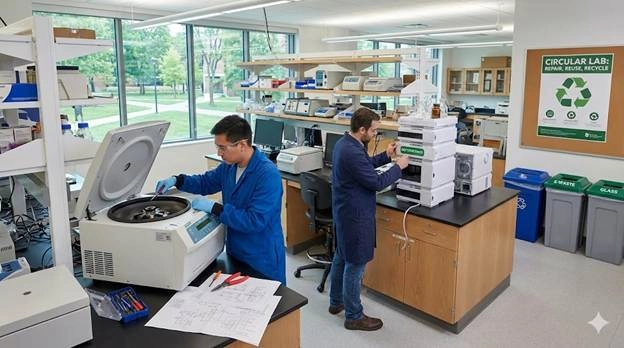
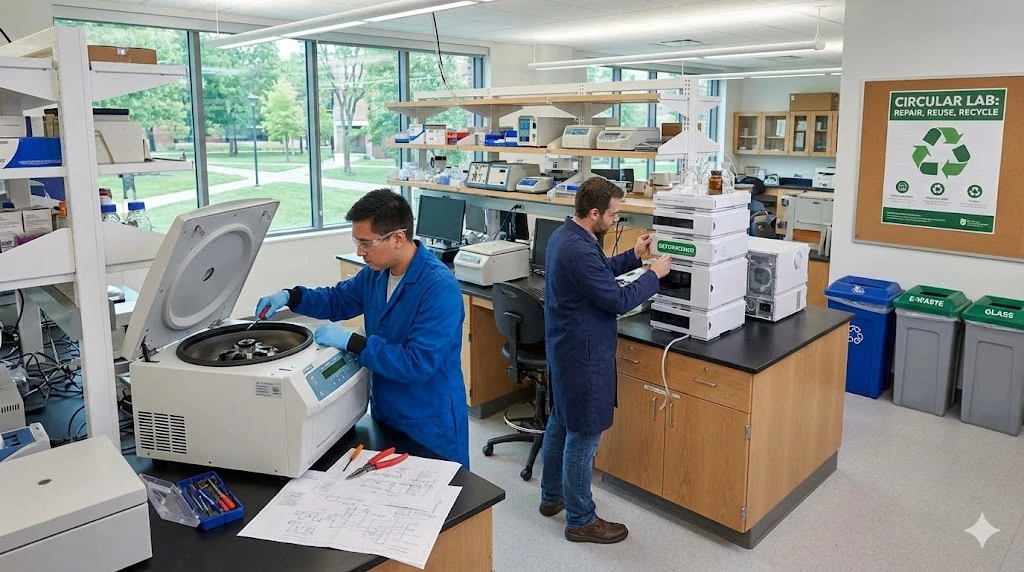
Integrating a circular economy framework into the lifecycle of laboratory equipment provides a critical pathway to reduce clinical and research waste. A circular economy prioritizes resource recovery, continuous instrument usage, and waste elimination over the traditional linear model of consumption and disposal. Modern analytical and clinical laboratories generate significant volumes of electronic and plastic waste annually. This waste contributes heavily to global carbon emissions. Implementing sustainable procurement and maintenance protocols directly addresses this severe environmental burden. Extending the operational life of complex analytical instruments, high-speed centrifuges, and ultra-low temperature refrigeration units mitigates supply chain vulnerabilities. Sustainable laboratory practices align with global environmental directives and support institutional carbon neutrality goals. Reducing reliance on newly manufactured devices lowers overall capital expenditure. This financial shift frees up funding for essential research personnel and critical consumables. A fundamental shift toward sustainable asset management transforms laboratories from high-consumption facilities into models of ecological responsibility.
Core Principles of the Circular Economy for Laboratory Equipment
Understanding foundational sustainability frameworks enables facilities to transition away from linear consumption models. This transition moves operations toward regenerative resource management. The traditional linear economy relies on a consumption model that creates substantial ecological strain. Aggressive resource extraction and unchecked electronic waste generation drive this impact. A circular economy redefines this paradigm by designing out waste entirely. It keeps valuable materials in active use for as long as possible. For laboratory equipment, this translates directly to prioritizing inherent repairability, modular component upgrades, and comprehensive end-of-life material recovery. The World Health Organization (WHO) emphasizes the urgent need for sustainable healthcare and research infrastructure. The WHO guidance on climate-resilient and environmentally sustainable health care facilities outlines strategies to minimize institutional ecological footprints. Applying these regenerative concepts to high-value laboratory assets requires systemic changes across procurement, daily operation, and decommissioning phases. Facility managers must evaluate equipment based on total lifecycle impact rather than solely considering the initial acquisition cost.
|
Economic Model |
Equipment Lifecycle Phase |
Environmental and Financial Impact |
|
Linear Economy |
Take-Make-Dispose Paradigm |
High carbon emissions, rapid budget depletion, substantial electronic waste generation. |
|
Circular Economy |
Repair, Reuse, and Refurbish |
Maximized capital investment, reduced landfill waste, lower greenhouse gas emissions. |
To successfully implement these principles, institutions must foster a culture of sustainability among bench scientists, core facility managers, and procurement officers. Purchasing decisions dictate the downstream environmental impact of every laboratory operation. Selecting modular equipment allows technicians to replace single failing components rather than discarding entire systems. This approach heavily reduces the demand for rare earth metals and complex polymers required to manufacture new laboratory devices.
Financial and Environmental Benefits of Refurbishing Laboratory Equipment
Refurbishing and re-certifying analytical devices yields substantial financial savings. This practice also significantly lowers the operational carbon footprint of research facilities. Purchasing refurbished laboratory equipment provides a highly cost-effective alternative to acquiring brand-new devices. Certified refurbishment processes restore aging instruments to original manufacturer specifications. This ensures analytical precision, data integrity, and mechanical reliability. This regenerative approach extends the functional lifespan of complex machinery, such as high-performance liquid chromatography systems, mass spectrometers, and automated liquid handlers. The United States Environmental Protection Agency (EPA) highlights electronic waste as the fastest-growing solid waste stream globally. Refurbishing scientific instruments directly counters this concerning environmental trend.
- Financial benefits: Organizations routinely save between thirty and seventy percent on capital equipment expenditures by selecting refurbished models.
- Environmental benefits: Keeping heavy instrumentation out of landfills prevents the leaching of heavy metals, hazardous refrigerants, and toxic electronic components into local soil and groundwater.
- Operational benefits: Refurbished equipment often features shorter procurement lead times compared to newly manufactured systems. This allows laboratories to expand testing capacities rapidly.
Re-certification involves rigorous calibration and validation protocols, guaranteeing strict compliance with industry standards. Qualified engineers perform comprehensive installation qualification, operational qualification, and performance qualification testing on all refurbished assets. These strict testing parameters ensure that pre-owned devices can perform comparably to newly manufactured counterparts when properly certified. Consequently, laboratories achieve high-level analytical performance without generating the substantial carbon emissions associated with new manufacturing supply chains.
Establishing In-House Repair and Maintenance Programs for Laboratory Equipment
Developing internal maintenance capabilities empowers laboratory personnel to resolve minor equipment failures rapidly. This extends overall asset longevity. Preventive maintenance serves as the cornerstone of any sustainable laboratory equipment management strategy. Establishing a dedicated in-house repair program requires investing significantly in technician training. It also requires maintaining a comprehensive inventory of critical replacement parts. Routine calibration, meticulous cleaning, and scheduled component inspection actively prevent catastrophic system failures and costly unplanned downtime. The Occupational Safety and Health Administration (OSHA) mandates safe working environments. This strictly includes the proper functional upkeep of potentially hazardous laboratory devices. Examples include class II biosafety cabinets, chemical fume hoods, and high-pressure autoclaves.
Internal programs substantially reduce institutional reliance on expensive ex
ternal service contracts for basic troubleshooting and routine component replacements. Training laboratory staff to perform basic user-level maintenance fosters a strong sense of ownership and accountability regarding equipment care.
- Daily maintenance: Emptying solvent waste receptacles, checking pump pressures, inspecting vacuum seals, and verifying ambient temperature logs.
- Monthly maintenance: Replacing minor particulate filters, lubricating dynamic mechanical components, running software diagnostics, and performing multipoint baseline calibrations.
- Annual maintenance: Conducting full system operational validations, replacing heavily worn internal hardware components, and scheduling comprehensive professional regulatory audits.
Maintaining an organized digital log of all maintenance activities ensures regulatory compliance and provides valuable historical data for future troubleshooting. Leveraging a computerized maintenance management system allows laboratory managers to automate service reminders and track the exact lifecycle costs of every individual asset.
Partnering With Certified Refurbishers and Laboratory Equipment Take-Back Programs
Collaborating with specialized third-party vendors facilitates the responsible disposal and high-level recycling of obsolete laboratory assets. When internal repair becomes mechanically or financially unfeasible, external partnerships ensure complex equipment avoids municipal landfills. Original equipment manufacturers and certified third-party refurbishers frequently offer structured take-back programs. These specialized programs accept decommissioned laboratory equipment for meticulous parts harvesting, safe raw material recycling, or complete mechanical restoration. Engaging exclusively with certified vendors guarantees strict adherence to environmental regulations. It also ensures data security standards during the entire decommissioning process.
The Food and Drug Administration (FDA) provides strict guidelines on the remanufacturing of medical devices. These guidelines consistently overlap with clinical laboratory equipment standards. This overlap ensures high patient and operator safety. Facilities must establish standard operating procedures for decontaminating equipment prior to shipping to external partners.
- Decontamination verification: Securing signed certificates confirming the complete removal of all biological, chemical, and radiological hazards prior to transit.
- Data sanitization: Physically destroying hard drives or utilizing compliant wiping protocols. This erases proprietary research from connected laboratory information management systems.
- Vendor auditing: Reviewing the downstream material recycling practices of third-party partners to confirm adherence to zero-landfill policies.
Structured partnerships transform end-of-life disposal from an operational liability into a sustainable asset recovery process. Some vendors offer financial credits for traded-in equipment. Facilities can apply these credits toward the purchase of upgraded instruments or essential laboratory consumables.
Key Metrics to Track Circular Economy Success for Laboratory Equipment
Establishing quantitative metrics to track environmental and financial gains remains essential for validating the success of sustainable procurement strategies. Tracking the return on investment for refurbished laboratory equipment requires financial oversight. Facilities must continuously compare initial purchase savings against long-term lifecycle maintenance costs. Laboratories must monitor the total mass of electronic waste diverted from landfills annually. This data helps calculate precise carbon footprint reductions and validate corporate sustainability claims. Measuring the average lifespan extension of properly maintained instruments provides actionable data regarding the true efficacy of internal repair programs. Documenting energy consumption differences between newer energy-efficient models and well-maintained legacy systems further informs future purchasing decisions. Facilities should track key performance indicators such as internal repair turnaround time and vendor take-back volume. Overall equipment effectiveness also offers a comprehensive, data-driven view of operational sustainability. Facilities utilizing computerized tracking systems can automatically generate quarterly sustainability reports. These reports highlight financial savings and environmental impact metrics for institutional stakeholders.
Conclusion: Advancing Sustainability Through Circular Laboratory Equipment Management
Transitioning toward a circular economy represents a necessary operational evolution for modern scientific and clinical facilities. Maximizing the functional utility of laboratory equipment systematically minimizes ecological harm. This requires targeted repair, rigorous preventive maintenance, and certified refurbishment. Strategic external partnerships and internal protocol adjustments yield highly measurable financial and environmental benefits. Adopting these regenerative practices ensures the long-term financial viability of complex research operations. It also firmly demonstrates an institutional commitment to global sustainability objectives. Facilities prioritizing the circular economy lead the scientific community in responsible resource management and ecological stewardship.
Frequently Asked Questions About Sustainable Laboratory Equipment
What Defines a Circular Economy in a Laboratory Setting?
A circular economy in a laboratory setting involves shifting away from disposable consumption toward practices that keep equipment and materials in active use. This framework prioritizes routine equipment repair, purchasing refurbished instruments, and utilizing vendor take-back programs to prevent electronic waste generation.
Does Refurbished Laboratory Equipment Meet Standard Compliance Regulations?
Yes, properly refurbished laboratory equipment undergoes rigorous calibration and validation protocols before redeployment. Certified vendors perform comprehensive installation, operational, and performance qualification testing to ensure instruments meet original manufacturer specifications and all relevant industry compliance standards.
How Do Take-Back Programs Reduce Electronic Waste?
Take-back programs allow facilities to return obsolete or broken equipment directly to manufacturers or specialized scientific recyclers. These entities harvest functional components for future repairs and safely recycle hazardous materials, preventing complex electronic devices from entering standard municipal landfills.
What Represents the First Step to Implementing an In-House Repair Program?
The first step involves conducting a comprehensive inventory audit to identify critical equipment and assess current maintenance needs. Following the audit, facilities must invest in specialized technician training and procure an inventory of high-use replacement parts to handle routine repairs internally.
This article was created with the assistance of Generative AI and has undergone editorial review before publishing.
Feb 19, 2026
Technical Insight
Circular Economy in Laboratory Equipment: How to Adopt Repair, Reuse, and Refurbishment Strategies
Adopting a circular economy for laboratory equipment minimizes environmental impact while maximizing instrument lifespan and optimizing laboratory budgets.
Feb 12, 2026
Product News
$5M+ in GMP Biopharma Manufacturing & QC Equipment Heads to Online Auction
A Southern California GMP manufacturing and clinical-stage QC laboratory is liquidating new and late-model equipment and unused inventory in an online auction opening February 11, 2026

Feb 12, 2026
Product News
2026 SLAS: Inspiration Catalyzing Discovery
A LabX look at the annual conference and exhibition, a key forum for networking, collaboration, and advancement of new technologies
Feb 11, 2026
Product News
Angstrom Scientific Named U.S. Distributor for Radalytica’s RadalyX Robotic X-ray and CT System
Angstrom Scientific, known for representing microscopy and materials analysis technologies across North America, adds Radalytica’s robotic X-ray and CT platform to its portfolio of analytical and imaging solutions.

Feb 10, 2026
Technical Insight
Eco-Friendly Refrigeration: Evaluating Natural Refrigerants and Low-GWP Cooling Systems
This guide explains the operational and environmental benefits of adopting natural refrigerants and low-GWP cooling systems in laboratory settings
Feb 10, 2026
Technical Insight
The Ultimate Guide to Sustainability in Laboratory Equipment and Operations
A comprehensive analysis of sustainable laboratory practices, focusing on energy-efficient equipment, waste management, and digital workflows

Jan 09, 2026
Product News
BRANDTECH Scientific Introduces the Transferpette® pro Micropipette: A New Twist on Comfort and Control
The latest addition to its trusted line of precision liquid handling instruments, engineered for comfort, control, and repeatable accuracy.

Jan 06, 2026
Featured, Technical Insight
New Research Frontiers Unlocked by Next-Generation Flow Cytometry
Next-generation flow cytometry systems using acoustic focusing are opening entirely new areas of research that were previously impractical or inaccessible with conventional flow cytometers.
Jan 05, 2026
Buying Guides
The Bottom Line: How Smart Microcentrifuge Tube Choices Impact Lab Efficiency and Cost
Innovative microcentrifuge tube solutions are more than just lab consumables—they’re strategic tools that can reduce costs, improve outcomes, and support long-term sustainability goals.
Jan 05, 2026
Buying Guides
Future-Proofing Your Lab with Innovative Microcentrifuge Tube Solutions
As laboratories evolve to meet the growing demands of modern science, even the most basic tools—like microcentrifuge tubes—are being reimagined.