
The Best Confocal Microscopes of 2026

Written By: Craig Bradley
Jan 05, 2026
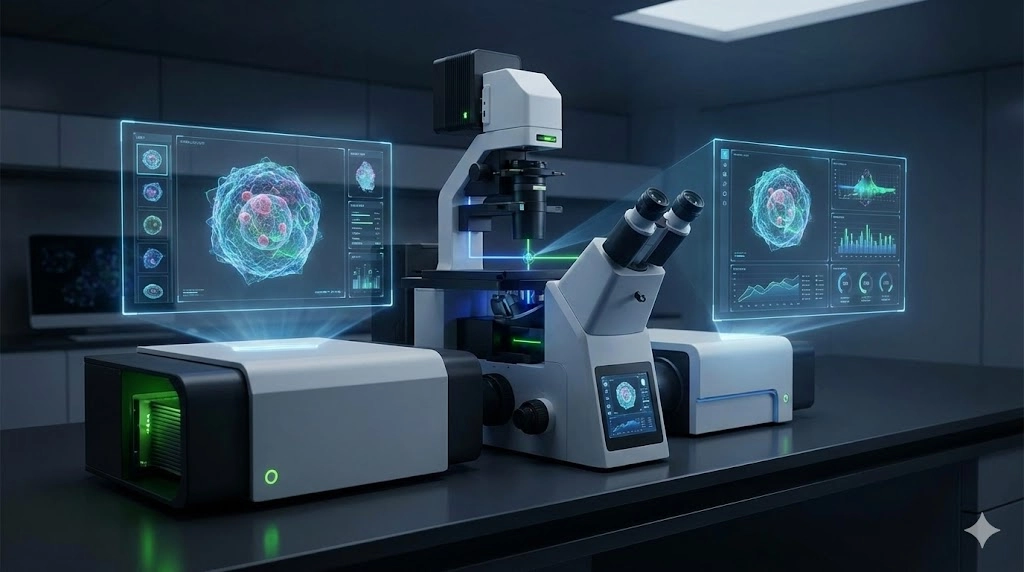
Selecting the best confocal microscopes of 2026 requires a careful evaluation of detection sensitivity, scanning speed, and software integration to meet the demands of modern biological research. Laboratory professionals must navigate a market where traditional photomultiplier tubes are being replaced by advanced silicon detectors and AI-driven processing is becoming standard for super-resolution imaging. High-performance systems now prioritize phototoxicity reduction and instant volumetric data capture, making the choice of equipment critical for core facilities and individual laboratories alike. This analysis reviews five industry-leading models, highlighting recent technological shifts that define the current landscape of optical microscopy.
Quick Summary
Best Overall: Zeiss LSM 990 with Lightfield 4D — The 2025 flagship combining instant volumetric imaging with Airyscan sensitivity for unparalleled 4D observation.
Best On A Budget: Andor BC43 — A compact benchtop spinning disk solution that delivers high-speed confocal imaging at an accessible price point.
Best For Speed / Throughput: Nikon AX R with NSPARC 2K — Features a newly updated spatial array detector and ultra-large field of view for rapid, high-resolution screening.
Most Versatile: Leica Stellaris 8 — Distinguishes itself with a fully tunable White Light Laser and TauSense technology for functional metabolic imaging.
Best For Quantitative Precision: Evident (Olympus) FLUOVIEW FV4000 — Utilizes next-generation SilVIR detection technology for linear, low-noise quantification across a massive dynamic range.
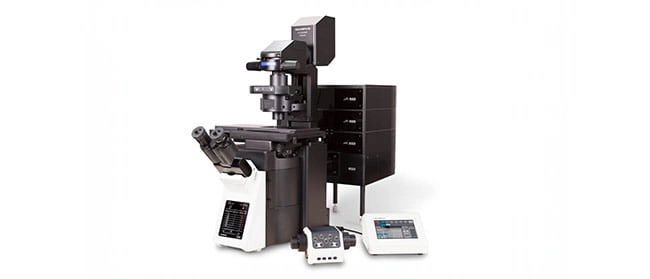
FLUOVIEW FV4000 – Evident
Price Range: $300,000 – $550,000 (Variable based on laser/detector config)
Best For: Quantitative Precision
Category: High-End Quantitative Imaging
Released in late 2023, the Evident (formerly Olympus) FLUOVIEW FV4000 represents a significant departure from legacy detection methods, replacing traditional Photomultiplier Tubes (PMTs) with SilVIR technology. This system is engineered for researchers requiring absolute quantitative accuracy and high dynamic range.
Key Specs
Detectors: SilVIR (Silicon Photomultiplier) technology for low noise and high linearity.
Spectral Range: 400 nm up to 900 nm, supporting NIR dyes.
Lasers: Supports up to 10 laser lines simultaneously.
Scanner: High-speed resonant scanner options available.
Dynamic Range: Significantly higher than standard GaAsP PMTs.
Performance & Applications The FV4000 excels in applications where intensity quantification is paramount, such as protein expression analysis and metabolic mapping. The SilVIR detectors provide a uniform sensitivity profile that eliminates the gain variability often found in traditional PMTs, allowing for more reliable data comparison between experiments. Its extended spectral range into the near-infrared (NIR) allows for higher multiplexing capabilities, enabling researchers to image up to six channels simultaneously without crosstalk. This model is particularly relevant for cancer research and developmental biology, where precise signal quantification and deep-tissue imaging using red-shifted dyes are routine requirements.
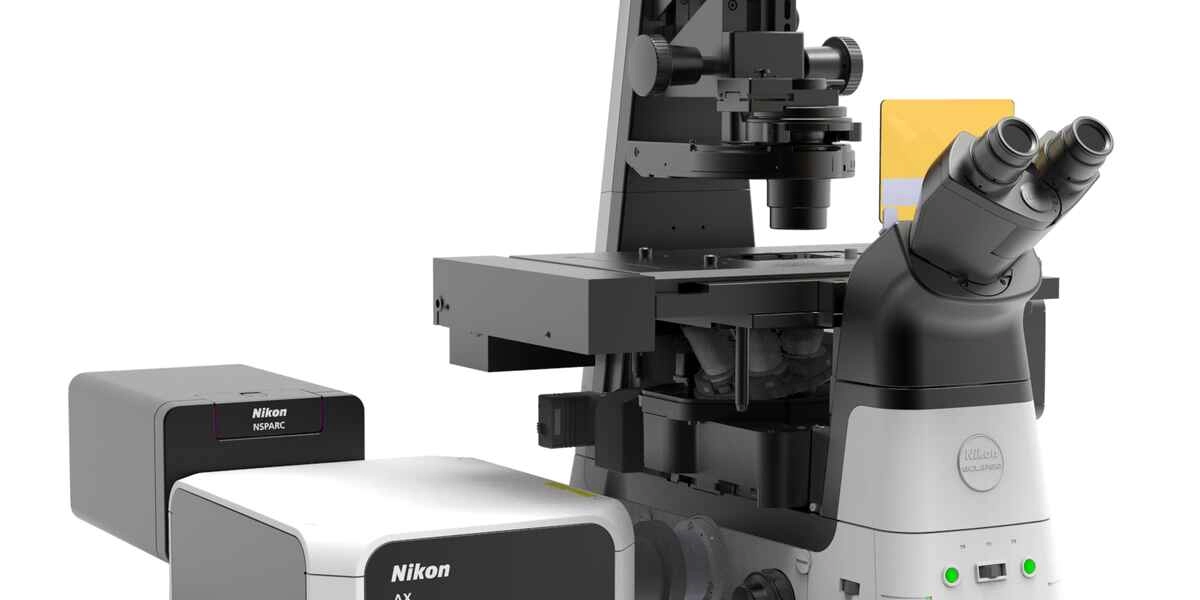
AX R with NSPARC 2K – Nikon
Price Range: $350,000 – $600,000
Best For: Speed / Throughput
Category: High-Speed Super-Resolution
Updated in mid-2024, the Nikon AX R with NSPARC 2K utilizes a unique approach to overcoming the trade-off between speed and resolution. By combining a lightning-fast resonant scanner with a spatial array detector, this system captures super-resolution data at frame rates necessary for tracking rapid biological processes, now with an even larger effective field of view.
Key Specs
Field of View: Ultra-large 25 mm effective scan field.
Resolution: NSPARC spatial array detection improves S/N ratio and resolution beyond the diffraction limit.
Scanner: High-speed resonant scanner (2048 x 2048 pixels).
AI Integration: Deep learning tools for denoising and segmentation.
Pixel Density: High sampling rates up to 8K x 8K.
Performance & Applications Operational efficiency is the primary strength of the AX R, making it ideal for high-throughput screening and large-volume 3D reconstruction. The NSPARC 2K update allows researchers to capture fine super-resolution details across a broader field of view, effectively capturing entire model organisms or large tissue sections in fewer tiles. This significantly reduces acquisition time compared to previous iterations. The detector enhances speed by collecting spatial information from a single pixel dwell time, serving neuroscience and physiology labs well—particularly those studying calcium dynamics or rapid vesicle transport where temporal resolution is as critical as spatial clarity.
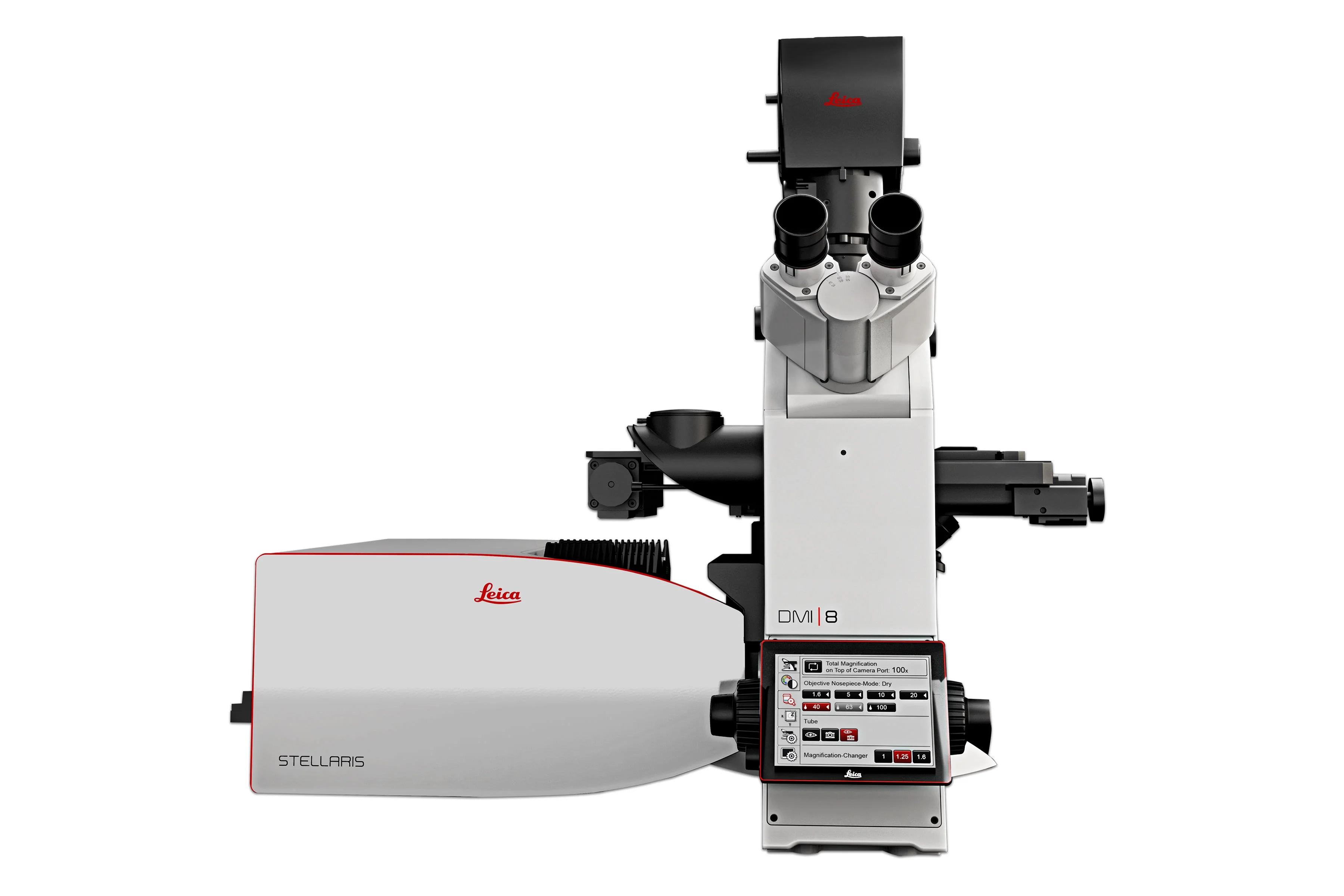
Stellaris 8 – Leica Microsystems
Price Range: $400,000 – $700,000
Best For: Versatility
Category: Versatile Functional Imaging
The Leica Stellaris 8 continues to set the standard for experimental flexibility in 2026. Its integration of a White Light Laser (WLL) allows for the excitation of any fluorophore at its exact peak efficiency, while the proprietary TauSense technology utilizes fluorescence lifetime information to separate overlapping spectra and remove autofluorescence.
Key Specs
Excitation: Fully tunable White Light Laser (440 nm – 790 nm).
Detection: Power HyD S and HyD X/R detectors for photon counting.
TauSense: Lifetime-based imaging tools (TauContrast, TauGating).
Scan Head: Tandem scanner (FOV and Resonant).
Channels: Up to 5 simultaneous spectral detection channels.
Performance & Applications The Stellaris 8 is the preferred instrument for core facilities serving a diverse user base with varying sample types. Its ability to tune excitation to the nanometer ensures that novel or faint fluorophores are imaged with maximum efficiency. Beyond standard intensity imaging, the TauSense modality allows users to distinguish between dyes with identical emission spectra based on their fluorescence lifetime, effectively increasing the number of simultaneous targets. This capability is crucial for metabolic sensing and microenvironmental studies in cell biology, where functional readouts like pH or ion concentration are derived from lifetime changes rather than simple intensity.
Shop Leica MIcrosystems on LabX
LSM 990 with Lightfield 4D – ZEISS
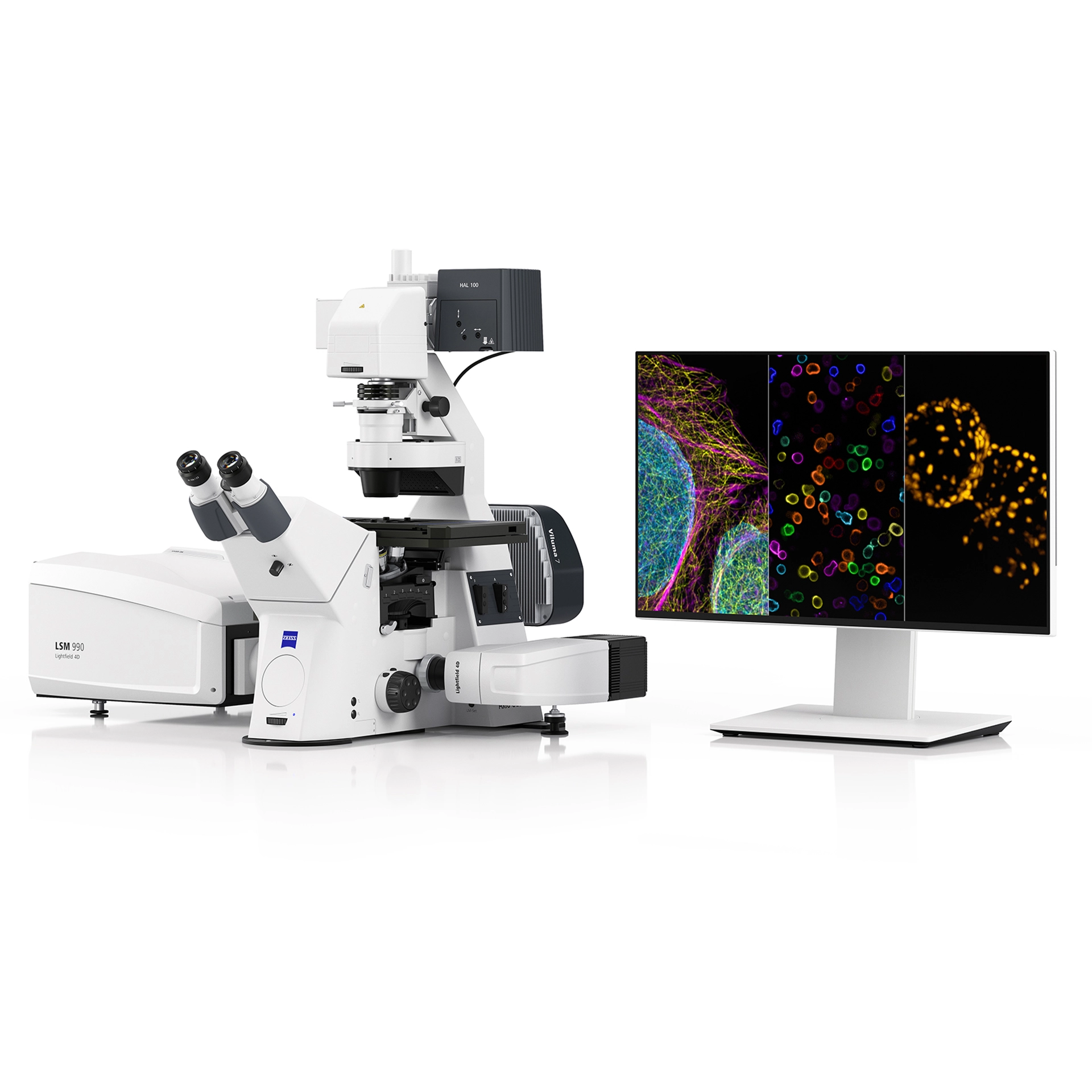
Price Range: $500,000 – $800,000
Best For: Overall Performance and Value
Category: High-End Volumetric Imaging
Released in early 2025, the Zeiss LSM 990 represents the next evolution of the renowned 980 series, introducing Lightfield 4D technology. This system redefines volumetric imaging by capturing entire 3D data sets instantly, eliminating the time lag inherent in traditional z-stacking.
Key Specs
Technology: Lightfield 4D for instant volume capture.
Detector: Airyscan 2 with jDCV for improved resolution and sensitivity.
Speed: Captures up to 80 volume Z-stacks per second.
Spectral Imaging: Enhanced high-bandwidth electronics for spectral flexibility.
Automation: AI-driven Smart Setup and sample navigation.
Performance & Applications The LSM 990 is designed for the most demanding dynamic imaging tasks. The integration of Lightfield 4D allows researchers to observe rapid physiological and neuronal processes in complete 3D volumes in real-time, rather than slice-by-slice. This "one snap, one volume" approach significantly reduces phototoxicity, making it the industry standard for long-term live imaging of sensitive model organisms. Combined with the super-resolution capabilities of the updated Airyscan detector, the LSM 990 offers an unmatched blend of speed, gentleness, and resolution for major research institutions.
BC43 – Andor
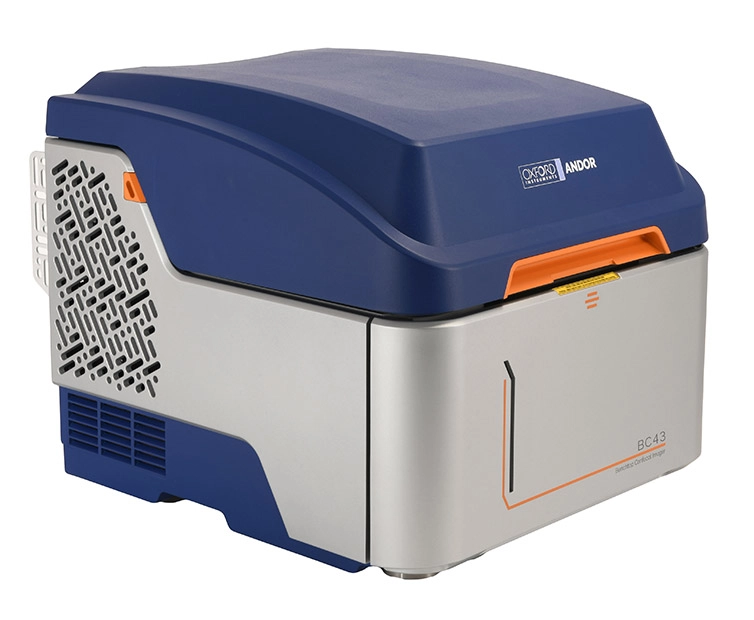
Price Range: $150,000 – $220,000
Best For: A Budget
Category: Benchtop Compact Confocal
Unlike the large point-scanning systems listed above, the Andor BC43 is a benchtop spinning disk confocal microscope designed for individual labs. It condenses high-speed confocal capabilities into a small footprint, removing the need for a dedicated darkroom or complex optical table setups.
Key Specs
Technology: High-speed spinning disk technology.
Footprint: Compact, enclosed box design (no darkroom needed).
Imaging Modes: Confocal, Widefield, and Brightfield.
Speed: Instant 3D capture suitable for fast live-cell dynamics.
Software: Integrated Imaris visualization tools.
Performance & Applications The BC43 democratizes access to confocal imaging by lowering the barriers of cost and complexity. It is particularly effective for developmental biology and live imaging of model organisms like C. elegans or Zebrafish, where the speed of a spinning disk is superior to point scanners. While it lacks the extreme spectral flexibility of a Stellaris or the deep tissue penetration of an FV4000, its ease of use allows for "walk-up and shoot" operation. This model remains an excellent supplementary instrument for labs that need routine 3D imaging without booking time on an expensive core facility system.
Comparison Table
Model | Best For | Key Features | Typical Price Range |
|---|---|---|---|
Zeiss LSM 990 | Best Overall | Lightfield 4D, Instant Volumetric Imaging | $500k – $800k |
Andor BC43 | Best on a Budget | Compact benchtop design, spinning disk speed | $150k – $220k |
Nikon AX R (2K) | Speed / Throughput | 25mm scan field, NSPARC 2K array detection | $350k – $600k |
Leica Stellaris 8 | Most Versatile | White Light Laser, TauSense lifetime imaging | $400k – $700k |
Evident FV4000 | Quantitative Precision | SilVIR detectors, 400-900nm dynamic range | $300k – $550k |
Conclusion: Choosing the Best Confocal Microscopes in 2026
The landscape of confocal microscopy in 2026 is defined by a shift toward instantaneous volumetric imaging and quantitative precision. Whether prioritizing the groundbreaking Lightfield 4D technology of the Zeiss LSM 990, the extreme dynamic range of the Evident FV4000, or the accessible speed of the Andor BC43, laboratory professionals now have specialized options that cater to distinct research needs. Choosing the right instrument involves balancing the requirement for super-resolution against the need for throughput and budget. Ultimately, these advanced confocal microscopes represent the pinnacle of optical engineering, enabling clearer insights into cellular function than ever before.
This article was created with the assistance of Generative AI and has undergone editorial review before publishing.
Feb 19, 2026
Technical Insight
Circular Economy in Laboratory Equipment: How to Adopt Repair, Reuse, and Refurbishment Strategies
Adopting a circular economy for laboratory equipment minimizes environmental impact while maximizing instrument lifespan and optimizing laboratory budgets.
Feb 12, 2026
Product News
$5M+ in GMP Biopharma Manufacturing & QC Equipment Heads to Online Auction
A Southern California GMP manufacturing and clinical-stage QC laboratory is liquidating new and late-model equipment and unused inventory in an online auction opening February 11, 2026

Feb 12, 2026
Product News
2026 SLAS: Inspiration Catalyzing Discovery
A LabX look at the annual conference and exhibition, a key forum for networking, collaboration, and advancement of new technologies
Feb 11, 2026
Product News
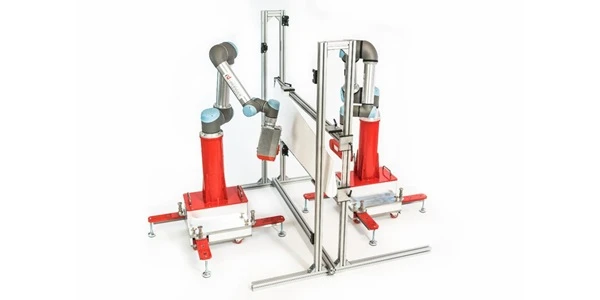
Angstrom Scientific Named U.S. Distributor for Radalytica’s RadalyX Robotic X-ray and CT System
Angstrom Scientific, known for representing microscopy and materials analysis technologies across North America, adds Radalytica’s robotic X-ray and CT platform to its portfolio of analytical and imaging solutions.

Feb 10, 2026
Technical Insight
Eco-Friendly Refrigeration: Evaluating Natural Refrigerants and Low-GWP Cooling Systems
This guide explains the operational and environmental benefits of adopting natural refrigerants and low-GWP cooling systems in laboratory settings

Feb 10, 2026
Technical Insight
The Ultimate Guide to Sustainability in Laboratory Equipment and Operations
A comprehensive analysis of sustainable laboratory practices, focusing on energy-efficient equipment, waste management, and digital workflows
Jan 09, 2026
Product News
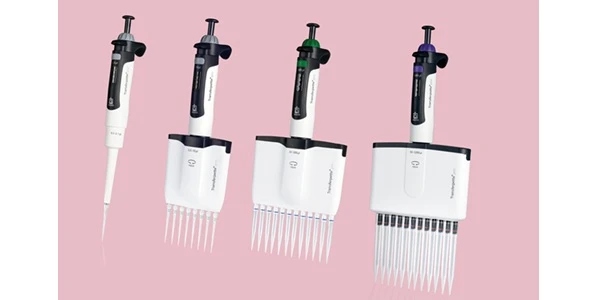
BRANDTECH Scientific Introduces the Transferpette® pro Micropipette: A New Twist on Comfort and Control
The latest addition to its trusted line of precision liquid handling instruments, engineered for comfort, control, and repeatable accuracy.

Jan 06, 2026
Featured, Technical Insight
New Research Frontiers Unlocked by Next-Generation Flow Cytometry
Next-generation flow cytometry systems using acoustic focusing are opening entirely new areas of research that were previously impractical or inaccessible with conventional flow cytometers.
Jan 05, 2026
Buying Guides
The Bottom Line: How Smart Microcentrifuge Tube Choices Impact Lab Efficiency and Cost
Innovative microcentrifuge tube solutions are more than just lab consumables—they’re strategic tools that can reduce costs, improve outcomes, and support long-term sustainability goals.
Jan 05, 2026
Buying Guides
Future-Proofing Your Lab with Innovative Microcentrifuge Tube Solutions
As laboratories evolve to meet the growing demands of modern science, even the most basic tools—like microcentrifuge tubes—are being reimagined.