
The Best Fermenters/Bioreactors of 2026

Written By: Craig Bradley
Dec 11, 2025
Selecting the right fermentation and cell culture systems is critical for laboratory professionals aiming to maximize yield and reproducibility in 2026. As fermenters/bioreactors evolve, recent innovations focus heavily on automation, single-use scalability, and seamless digital integration. This guide evaluates five models currently influencing the bioprocessing sector, highlighting equipment that balances operational efficiency with advanced process control for both academic and industrial settings. Quick Summary Best For High Throughput: Ambr 250 High Throughput Gen 2 (Sartorius) — Fully automated parallel processing for rapid clone selection. Best For Scalability: HyPerforma DynaDrive (Thermo Fisher Scientific) — Seamless single-use scaling from benchtop to production. Best High-End Option: X-platform Bioreactors (Cytiva) — Ergonomic, GMP-ready systems with comprehensive automation features. Most Versatile: Livit Flex (Getinge/Applikon) — flexible controller adaptable to both reusable and single-use vessels. Best On A Budget: MINIFOR (Lambda Instruments) — Compact, cost-effective design with innovative infrared heating. Best For: Automated High-Throughput Process Development Key Specs Vessel Volume: 100 mL – 250 mL single-use vessels Parallelism: Runs 12 or 24 bioreactors simultaneously Automation: Integrated liquid handling for feeding and sampling Control: Individual control of pH, DO, temperature, and stirring for each vessel Performance & Applications
The Sartorius Ambr 250 High Throughput (Gen 2) serves as a benchmark for scale-down models, specifically engineered for efficiency in early-stage process development. Officially launched in late 2025, this second-generation system allows laboratories to screen dozens of conditions in parallel without the manual labor typically associated with benchtop reactors. Its relevance to scientific research lies in its ability to mimic larger production scales accurately, making it integral for Design of Experiments (DoE) studies, clone selection, and media optimization in biopharmaceutical workflows. Price Range: $40,000 – $120,000 (Hardware); Consumables vary
Best For: Seamless Scalability Key Specs Volume Range: 5 L to 5,000 L (5 L released April 2025) Drive Train: Unique cubic mixing design for high power input Turndown Ratio: Up to 20:1 (allows low volume seed train in same vessel) Platform: Single-use bioprocess container (BPC) system Performance & Applications
Thermo Fisher Scientific completed the HyPerforma DynaDrive line in Spring 2025 with the release of the 5 L model, effectively bridging the gap between benchtop R&D and commercial manufacturing. A key feature is the DynaDrive powertrain, which delivers high torque and mixing power, enabling the processing of very high cell densities (VCD) that traditional single-use mixers may not support. This system is particularly effective for perfusion processes and intensified fed-batch cultures where maintaining oxygen transfer rates (kLa) at high volumes is a primary operational challenge. Price Range: $80,000 – $250,000+
Best For: High-End GMP Manufacturing Key Specs Sizes: 50 L, 200 L, 500 L, 2000 L (Expanded March 2025) Automation: Figurate automation software integration Design: Ergonomic lowering mechanisms for easy bag installation Sensors: Smart sensors for real-time foam and pressure monitoring Performance & Applications
Building on the legacy of the Xcellerex line, Cytiva’s X-platform represents an advanced tier of single-use manufacturing, with a major portfolio expansion in March 2025 that added 500 L and 2,000 L capacities. These units are designed to address common pain points in GMP environments, such as operator ergonomics and turnover speed. The inclusion of advanced sensors and process analytical technology (PAT) capabilities makes the X-platform suitable for producing monoclonal antibodies (mAbs), vaccines, and viral vectors where regulatory compliance and batch consistency are required. Price Range: $25,000 – $45,000
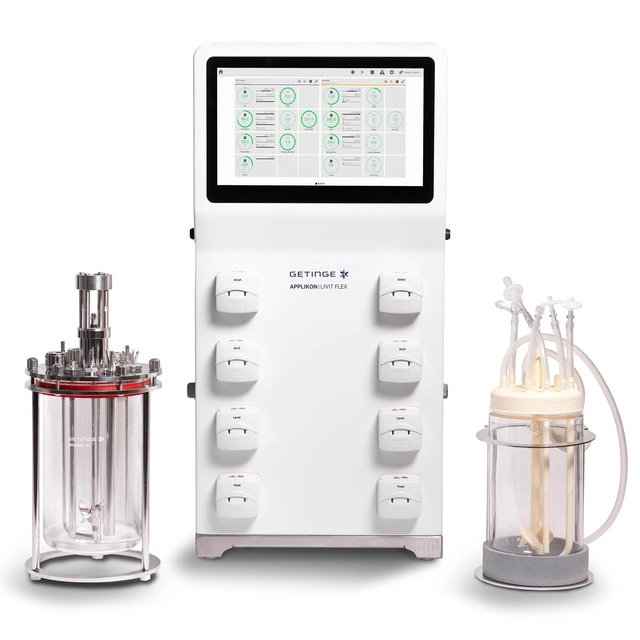
Best For: Versatile R&D Key Specs Compatibility: Works with multi-use (glass) and single-use vessels Interface: Tablet-based, intuitive software interface Configuration: "Smart" sensors reduce cable clutter Scalability: Controls multiple vessels from one station Performance & Applications
The Getinge Livit Flex is an adaptable bioprocess controller designed to upgrade the academic and industrial R&D benchtop. Since its market debut, it has become a frequent choice for its versatility; labs can switch between autoclavable glass bioreactors for microbial fermentation and single-use vessels for cell culture without changing the control hardware. This flexibility makes it a suitable option for contract research organizations (CROs) and university core facilities that handle diverse projects ranging from yeast fermentation to mammalian cell line development. Price Range: $5,000 – $12,000
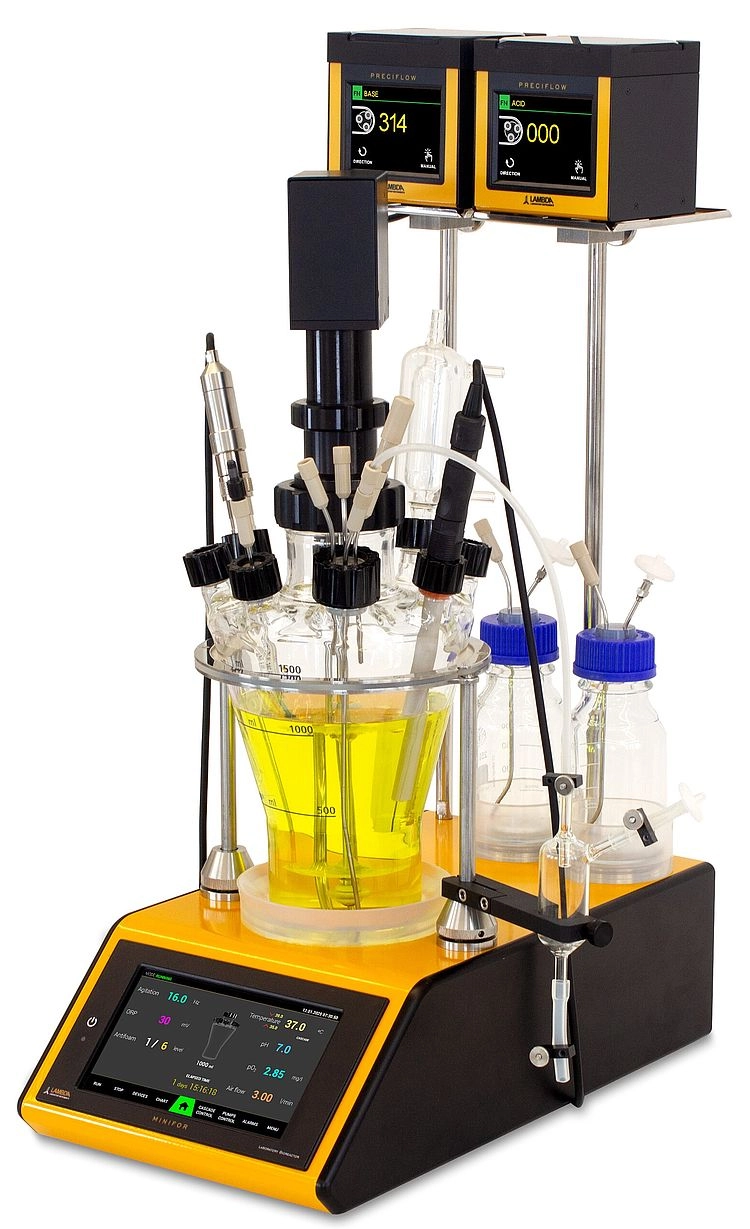
Best For: Budget & Compact Spaces Key Specs Volume: 0.3 L to 7 L interchangeable glass vessels Heating: Infrared radiator (eliminates water bath/jackets) Agitation: Novel "fish-tail" non-rotational stirring option Footprint: Extremely compact (approx. size of a sheet of paper) Performance & Applications
The Lambda MINIFOR remains a common selection for labs facing budget constraints or limited bench space, with new sensor integration options (including enhanced mass flow controllers) keeping it relevant in 2026. Unlike traditional fermenters that require bulky water baths or chillers, the MINIFOR uses a specific infrared heating system to maintain temperature, significantly reducing complexity and setup time. It is widely used in academic microbiology and protein expression studies where simple, reliable, and cost-effective continuous operation is required. Model Best For Key Features Typical Price Range Ambr 250 HT Gen 2 High Throughput Fully automated, 12-24 parallel vessels, integrated analysis $150k – $300k+ HyPerforma DynaDrive Scalability 20:1 turndown ratio, high-power mixing, 5L–5000L range $40k – $120k+ X-platform High-End GMP Ergonomic design, Figurate automation, smart sensors $80k – $250k+ Livit Flex Versatile R&D Multi- & single-use compatible, tablet interface $25k – $45k MINIFOR Budget / Compact IR heating, small footprint, interchangeable vessels $5k – $12k The landscape of bioprocessing in 2026 is defined by a shift toward smarter, more scalable solutions that reduce the risk of batch failure. Whether a laboratory requires the high-volume data generation capabilities of the Sartorius Ambr 250 or the reliability of the Lambda MINIFOR, there is a system tailored to every stage of development. Investing in the right fermenters/bioreactors now ensures that research facilities remain competitive and capable of meeting the increasing demands of modern biotechnology. This article was created with the assistance of Generative AI and has undergone editorial review before publishing.
Ambr 250 High Throughput Gen 2 – Sartorius
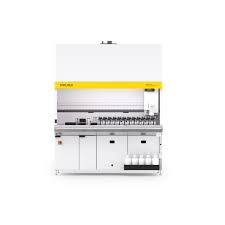 Price Range: $150,000 – $300,000+ (System dependent)
HyPerforma DynaDrive – Thermo Fisher Scientific
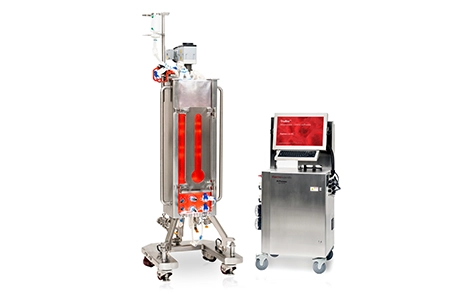
X-platform Bioreactors – Cytiva
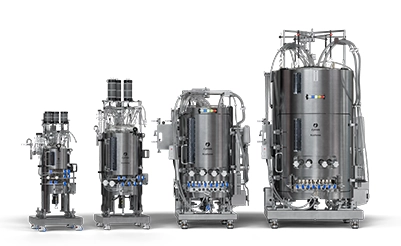
Livit Flex – Getinge (Applikon)
MINIFOR – Lambda Instruments
Comparison Table
Conclusion: Selecting the Best Fermenters/Bioreactors for 2026
Jan 09, 2026
Product News
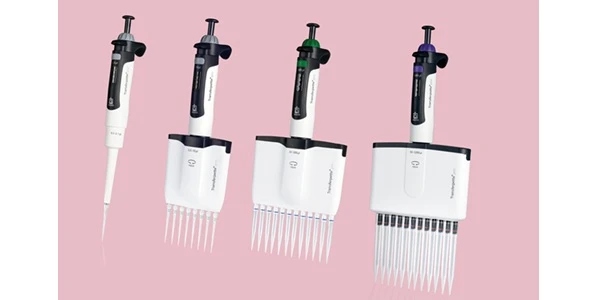
BRANDTECH Scientific Introduces the Transferpette® pro Micropipette: A New Twist on Comfort and Control
The latest addition to its trusted line of precision liquid handling instruments, engineered for comfort, control, and repeatable accuracy.
Jan 06, 2026
Featured, Technical Insight
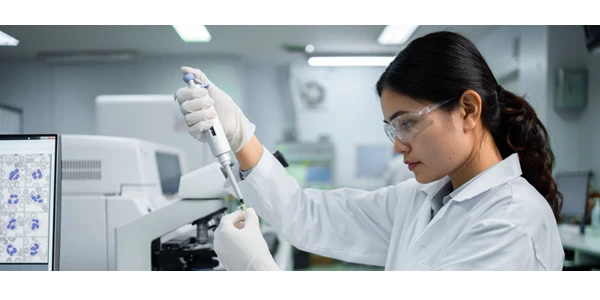
New Research Frontiers Unlocked by Next-Generation Flow Cytometry
Next-generation flow cytometry systems using acoustic focusing are opening entirely new areas of research that were previously impractical or inaccessible with conventional flow cytometers.
Jan 05, 2026
Buying Guides
The Bottom Line: How Smart Microcentrifuge Tube Choices Impact Lab Efficiency and Cost
Innovative microcentrifuge tube solutions are more than just lab consumables—they’re strategic tools that can reduce costs, improve outcomes, and support long-term sustainability goals.
Jan 05, 2026
Buying Guides
Future-Proofing Your Lab with Innovative Microcentrifuge Tube Solutions
As laboratories evolve to meet the growing demands of modern science, even the most basic tools—like microcentrifuge tubes—are being reimagined.
Jan 05, 2026
Buying Guides
Microcentrifuge Tube Innovations: Driving Sustainable Change
Integrating next-generation consumables into standard workflows can lead to a more sustainable and responsible research environment.
Jan 05, 2026
Buying Guides
Single Use Plastics: How to Manage these Major Contributors to Lab Waste
Reducing lab waste isn’t just a sustainability issue—it’s a financial and operational one, too.
Jan 05, 2026
Buying Guides
Common Microcentrifuge Tube Challenges in Sensitive Molecular Workflows
Key factors that can impact the performance of microcentrifuge tubes for PCR, qPCR, and NGS and other sensitive applications
Jan 05, 2026
Buying Guides
How to Research the Right Microcentrifuge Tubes for Your Application
Selecting the right microcentrifuge tubes starts with understanding the specific demands of your application.
Jan 05, 2026
Technical Insight
The Best Confocal Microscopes of 2026
Discover the best confocal microscopes of 2026 for advanced imaging. Compare top models from Zeiss, Evident, and Nikon for speed, resolution, and budget.
Dec 24, 2025
Featured, Popular Products, Technical Insight
Emerging Mass Spectrometry Technologies to Improve Intraoperative Diagnostics
Advances in mass spectrometry may soon reshape surgery, improving diagnostic accuracy and impacting post-operative outcomes