
The Best Glassware of 2026: A Buyer's Guide to Price and Features

Written By: Craig Bradley
Aug 23, 2024
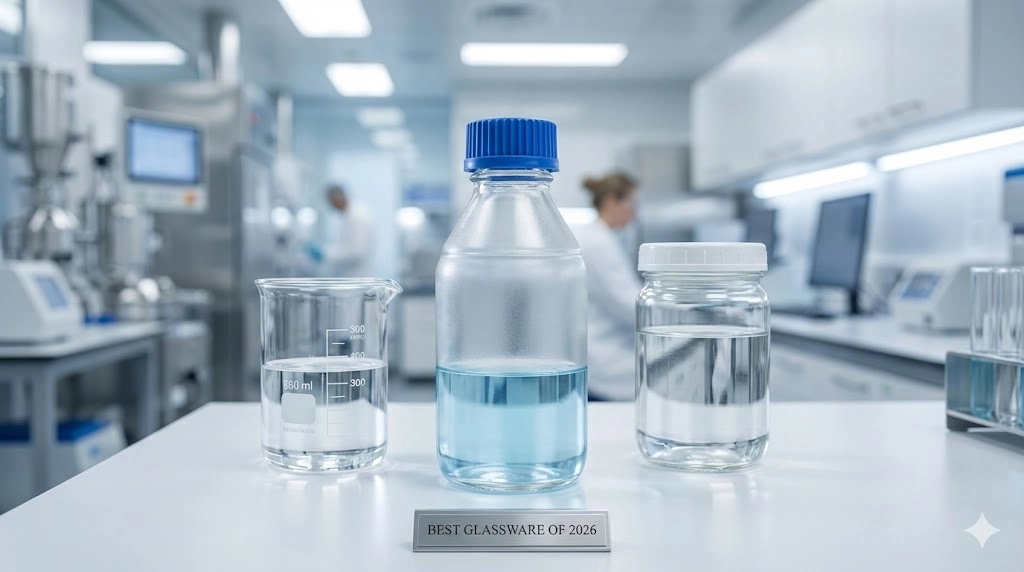
Selecting the best glassware of 2026 requires balancing traditional durability with modern innovations in safety and sustainability. Laboratory professionals understand that high-quality borosilicate glass is not merely a consumable but a critical component in maintaining assay integrity and safety standards. This year’s market shifts toward "smart" coatings that prevent shatter risks and ergonomic designs that reduce repetitive strain during high-throughput tasks. From advanced polymer-coated bottles to heavy-duty beakers designed for mechanized washing, the following equipment represents the pinnacle of current glass engineering.
Quick Summary Box
Best Overall: DURAN® protect+ Laboratory Bottle — Features a new advanced polyamide coating for superior shatter protection and chemical resistance.
Best On A Budget: Borosil® 3.3 Borosilicate Beakers — Delivers ASTM Type I Class A quality at a highly competitive price point for general lab use.
Best For Speed / Throughput: Kimble® GLS 80® Wide Mouth Media Bottle — The 80mm wide mouth facilitates rapid filling and accommodates large stir bars or powders easily.
Most Versatile: Borosil® PUREGRIP® Media Bottles — Combines premium glass with an ergonomic VersaCap® and large writing surfaces for diverse media handling.
Best High-End Option: Corning® Pyrex® Heavy Duty Griffin Beakers — Engineered with thicker walls to withstand harsh mechanical shocks and repeated autoclave cycles.
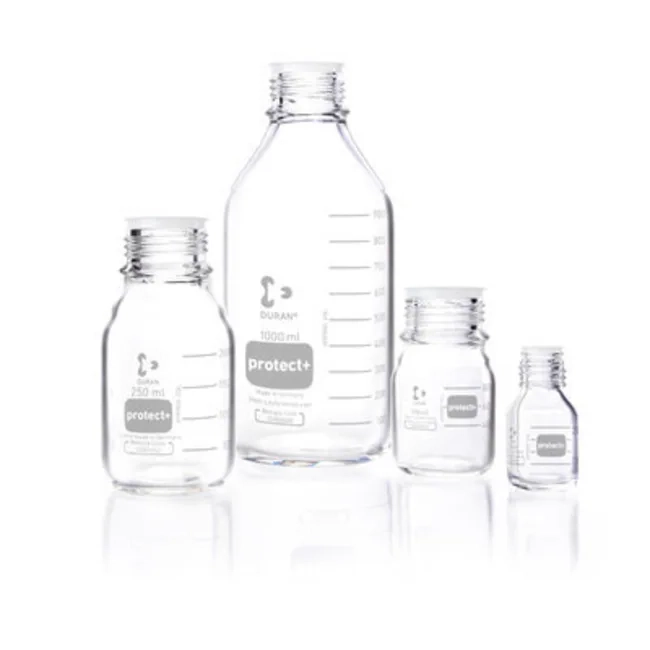
DURAN® protect+ Laboratory Bottle – DWK Life Sciences
Price Range: $250 – $600 per case (varies by size/pack count)
Best For: Safety & Sustainability
The DURAN® protect+ represents a significant 2024–2025 evolution in laboratory safety glass. This model replaces traditional coatings with a new, advanced polyamide protective layer. This innovation ensures that if the glass breaks, the coating holds the shards together, significantly reducing the risk of injury and spillage of hazardous contents.
Key Specs
Material: DURAN® borosilicate glass 3.3 with polyamide coating
Safety Feature: Retains contents and shards upon breakage
Temperature Resistance: Coating withstands up to 135°C
Compliance: USP <660> Type I neutral glass
Performance & Applications The primary operational strength of the protect+ line is its ability to maintain container integrity under physical stress. The new polyamide coating offers higher chemical resistance than previous generations, making it suitable for long-term storage of valuable reagents or hazardous active pharmaceutical ingredients (APIs). Ideally suited for biopharmaceutical production and high-traffic teaching laboratories, this bottle minimizes downtime caused by accidental breakage and simplifies cleanup protocols.
Borosil® PUREGRIP® Media Bottles – Borosil / Foxx Life Sciences

Price Range: $120 – $460 per case (typically 10 units)
Best For: Versatility
Introduced to the North American market to bridge the gap between economy and premium ergonomics, the PUREGRIP® line is a standout release gaining traction in 2024 and 2025. These bottles pair Borosil’s reliable 3.3 borosilicate glass with Foxx Life Sciences’ patented VersaCap® technology, offering a user-centric design often missing in standard media bottles.
Key Specs
Cap Design: VersaCap® with large ridges for easy gripping
Graduations: Highly visible, enamel-fused graduation marks
Material: USP Type I, 3.3 borosilicate glass
Traceability: Retrace code on every bottle
Performance & Applications The PUREGRIP® series excels in laboratories where technicians handle dozens of bottles daily. The ergonomic cap design reduces hand strain, while the sloped shoulders ensure smooth pouring without glugging. The distinct, large writing surface allows for clear labeling, reducing identification errors in busy media preparation kitchens. These bottles serve as excellent all-purpose vessels for culture media, buffer storage, and general solvent handling.
Kimble® GLS 80® Wide Mouth Media Bottle – DWK Life Sciences
Price Range: $200 – $800 per case (depending on volume)
Best For: Speed / Throughput
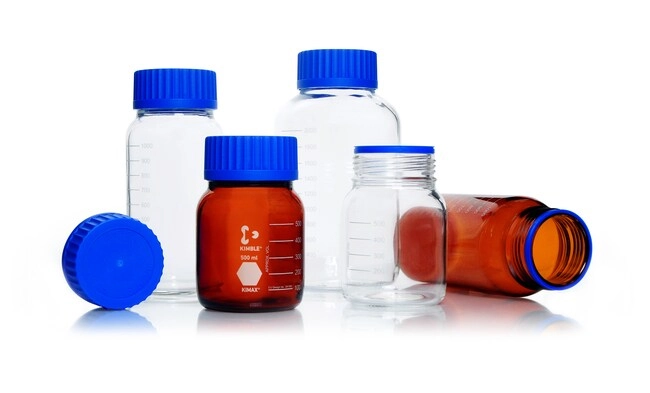
The Kimble® GLS 80® addresses a common bottleneck in laboratory workflows: the difficulty of filling standard narrow-neck bottles. With an 80mm wide mouth, this model allows researchers to easily add powders, pastes, and large magnetic stir bars without using funnels. Recent updates to the closure system, including multi-port cap options, have expanded its utility in complex setups.
Key Specs
Mouth Diameter: 80mm (wide mouth)
Thread Type: GLS 80 quick-release (turns 360° to open)
Material: Low-extractable borosilicate glass
Capacity Options: 250mL up to 20L
Performance & Applications Speed and accessibility define the performance of the GLS 80®. The wide opening simplifies cleaning and allows for the insertion of probes or large spoons, making it ideal for soil analysis, viscous liquid preparation, and formulation chemistry. The quick-turn thread mechanism further enhances throughput by reducing the time spent opening and closing vessels during repetitive sampling tasks.
Shop DWK Life Sciences on LabX
Corning® Pyrex® Heavy Duty Griffin Beakers – Corning
Price Range: $400 – $900 per case
Best For: High-End / Durability
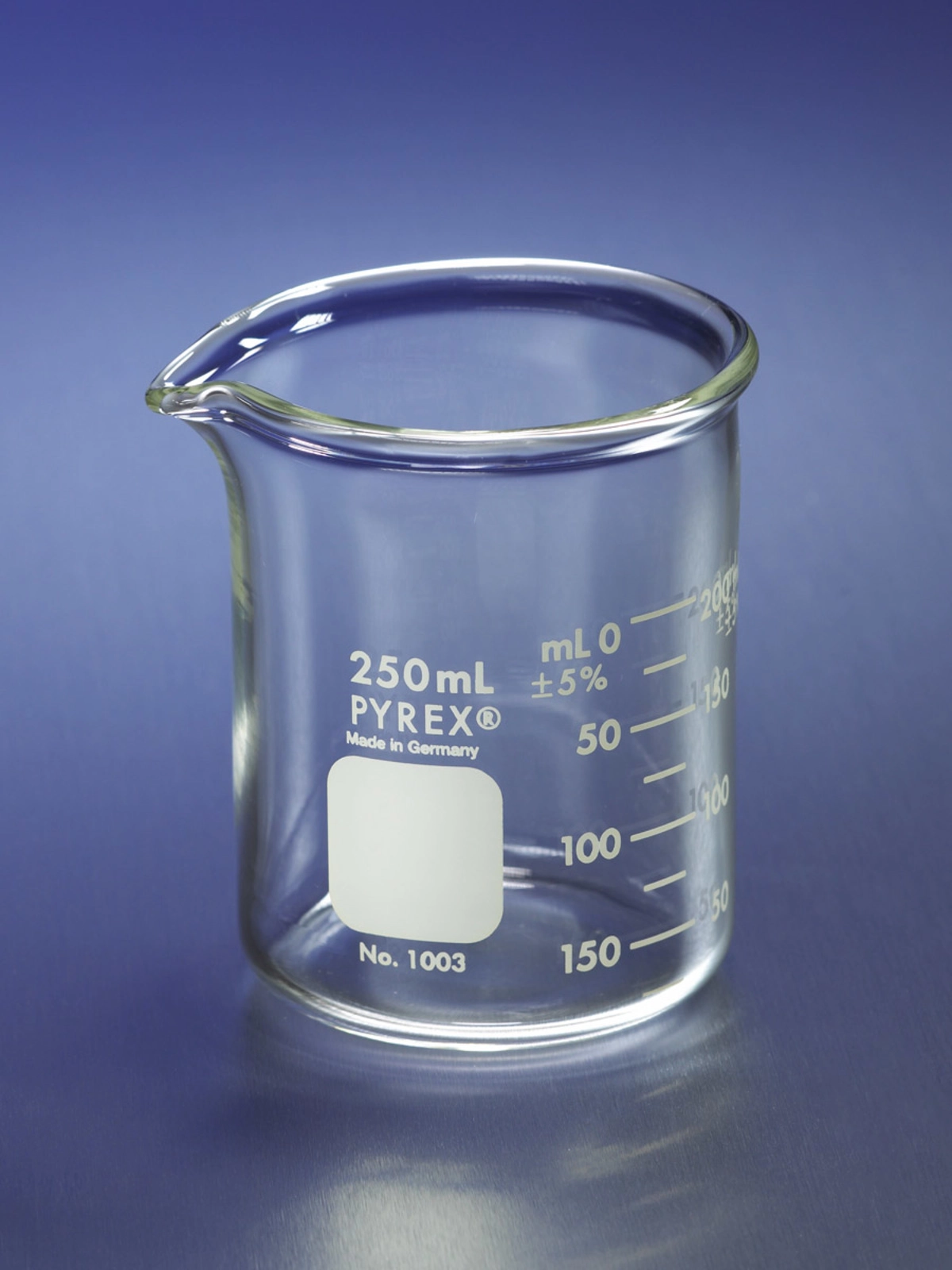
While not a brand-new release, the Pyrex® Heavy Duty series remains the gold standard for 2026 due to its unmatched mechanical strength. Corning designs these beakers specifically for harsh environments where standard glassware frequently fails. The heavy-duty designation indicates uniformly thicker walls and a reinforced rim and spout.
Key Specs
Construction: Heavy wall weight with reinforced rim
Material: Pyrex® borosilicate glass (Code 7740)
Graduations: Double-scale metric
Shock Resistance: Optimized for mechanical shock
Performance & Applications These beakers are engineered to survive the rigors of mechanized washing systems and rough handling. The reinforced rim significantly reduces chipping, a common failure point that renders glassware unsafe. They are the preferred choice for industrial quality control labs and high-volume academic settings where equipment longevity justifies the higher initial investment. Their robust nature makes them suitable for vigorous mixing and heating applications on hot plates.
Borosil® 3.3 Borosilicate Beakers – Borosil
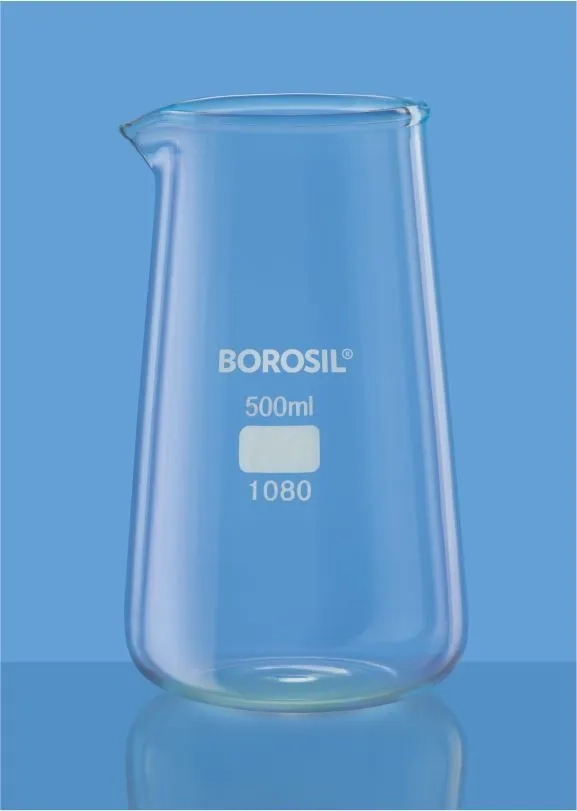
Price Range: $90 – $300 per case (highly economical)
Best For: Best On A Budget
Borosil has solidified its reputation for providing high-quality glass at a fraction of the cost of Western competitors. Their standard low-form Griffin beakers offer the essential properties of Type I borosilicate glass—thermal shock resistance and chemical inertness—without the price premium attached to legacy brands.
Key Specs
Material: 3.3 Low Expansion Borosilicate Glass
Standard: Meets ISO 3819 and DIN 12331 specifications
Design: Uniform wall thickness
Spout: Tooled for drip-free pouring
Performance & Applications For laboratories operating on tight grants or needing to stock large inventory quantities, these beakers provide reliable performance without compromise. They handle thermal stress efficiently and possess excellent chemical resistance to acids and alkalis. These models are widely utilized in educational labs, general chemistry startups, and facilities where consumable costs must be strictly managed.
Comparison Table
Model | Best For | Key Features | Typical Price Range (Case) |
|---|---|---|---|
DURAN® protect+ Bottle | Safety & Sustainability | Polyamide safety coating, shatter retention, high chemical resistance | $250 – $600 |
Borosil® PUREGRIP® | Versatility | Ergonomic VersaCap®, large writing area, easy-pour shape | $120 – $460 |
Kimble® GLS 80® | Speed / Throughput | 80mm wide mouth, quick-turn thread, easy access for solids | $200 – $800 |
Pyrex® Heavy Duty Beaker | High-End / Durability | Thicker walls, reinforced rim, mechanical shock resistance | $400 – $900 |
Borosil® 3.3 Beaker | Best On A Budget | ISO 3819 / DIN 12331 quality, economical pricing, uniform thickness | $90 – $300 |
Conclusion: Selecting the Best Glassware of 2026
The best glassware of 2026 prioritizes the safety of laboratory personnel and the longevity of equipment. Innovations like the DURAN® protect+ coating demonstrate the industry's shift toward materials that actively mitigate risk, while ergonomic designs from Borosil and wide-mouth options from Kimble enhance daily operational efficiency. By selecting the appropriate model—whether for heavy-duty durability or budget-conscious versatility—laboratories can ensure precise analytical results and a safer working environment.
This article was created with the assistance of Generative AI and has undergone editorial review before publishing.
Jan 09, 2026
Product News
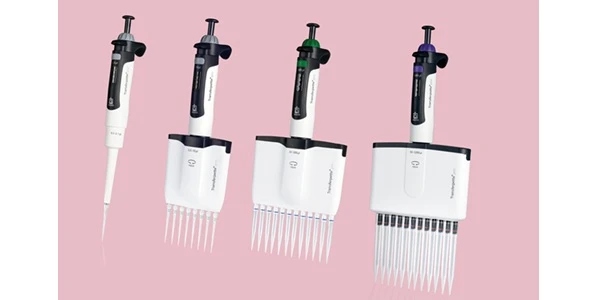
BRANDTECH Scientific Introduces the Transferpette® pro Micropipette: A New Twist on Comfort and Control
The latest addition to its trusted line of precision liquid handling instruments, engineered for comfort, control, and repeatable accuracy.

Jan 06, 2026
Featured, Technical Insight
New Research Frontiers Unlocked by Next-Generation Flow Cytometry
Next-generation flow cytometry systems using acoustic focusing are opening entirely new areas of research that were previously impractical or inaccessible with conventional flow cytometers.
Jan 05, 2026
Buying Guides
The Bottom Line: How Smart Microcentrifuge Tube Choices Impact Lab Efficiency and Cost
Innovative microcentrifuge tube solutions are more than just lab consumables—they’re strategic tools that can reduce costs, improve outcomes, and support long-term sustainability goals.
Jan 05, 2026
Buying Guides
Future-Proofing Your Lab with Innovative Microcentrifuge Tube Solutions
As laboratories evolve to meet the growing demands of modern science, even the most basic tools—like microcentrifuge tubes—are being reimagined.
Jan 05, 2026
Buying Guides
Microcentrifuge Tube Innovations: Driving Sustainable Change
Integrating next-generation consumables into standard workflows can lead to a more sustainable and responsible research environment.
Jan 05, 2026
Buying Guides
Single Use Plastics: How to Manage these Major Contributors to Lab Waste
Reducing lab waste isn’t just a sustainability issue—it’s a financial and operational one, too.
Jan 05, 2026
Buying Guides
Common Microcentrifuge Tube Challenges in Sensitive Molecular Workflows
Key factors that can impact the performance of microcentrifuge tubes for PCR, qPCR, and NGS and other sensitive applications
Jan 05, 2026
Buying Guides
How to Research the Right Microcentrifuge Tubes for Your Application
Selecting the right microcentrifuge tubes starts with understanding the specific demands of your application.
Jan 05, 2026
Technical Insight
The Best Confocal Microscopes of 2026
Discover the best confocal microscopes of 2026 for advanced imaging. Compare top models from Zeiss, Evident, and Nikon for speed, resolution, and budget.

Dec 24, 2025
Featured, Popular Products, Technical Insight
Emerging Mass Spectrometry Technologies to Improve Intraoperative Diagnostics
Advances in mass spectrometry may soon reshape surgery, improving diagnostic accuracy and impacting post-operative outcomes