
The Best Laboratory Chillers of 2026

Written By: Craig Bradley
Dec 05, 2025
Precise temperature control remains the backbone of reproducible results in pharmaceutical, chemical, and biological research. As environmental regulations tighten and thermal loads increase, the demand for a reliable lab chiller has never been higher. Modern units now prioritize natural refrigerants, adaptive cooling capacities, and integration with laboratory information management systems (LIMS) to reduce downtime. Selecting the right equipment requires navigating a complex market of cooling capacities, pump pressures, and connectivity options to match specific application needs. Best Overall: PolyScience DuraChill Portable — Features a patented self-changing filter system and dynamic noise reduction for hassle-free maintenance. Best On A Budget: Huber Minichiller 300 OLÉ — A compact, eco-friendly solution using natural refrigerants, ideal for standard cooling tasks without a high price tag. Best For Speed / Throughput: LAUDA Integral IN 130 T — Equipped with a powerful pressure pump and rapid dynamic temperature control for demanding external applications. Most Versatile: Julabo VALEGRO H Series — A 2025-released "all-rounder" offering precise control, natural refrigerants, and a wide working temperature range for diverse setups. Best High-End Option: Huber Unistat 825 — The gold standard for dynamic temperature control, offering an immense -85°C to 250°C range and responsive thermodynamics. Price Range: $8,500 – $11,500
Best For: Overall Reliability & Low Maintenance
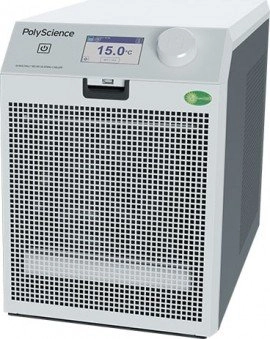
Primary Category: Best Overall Key Specs Temperature Range: -10°C to +40°C (Extended models to +70°C) Cooling Capacity: Up to 2.9 kW (at 20°C) Pump Type: Turbine or Positive Displacement options Display: Full-color touchscreen with multi-language support Performance & Applications
The PolyScience DuraChill Portable series consistently ranks as a top choice for general laboratory cooling due to its focus on minimizing user intervention. Its standout feature is the DynamicFilter™ system, which automatically changes the air filter cartridge when it detects saturation, eliminating a common cause of compressor failure. The WhisperCool™ noise reduction system adjusts fan speed based on load, making it significantly quieter than comparable units. This model serves well in analytical instrumentation cooling, laser etching, and reaction vessel temperature control where uptime and low noise are critical. Price Range: $5,500 – $6,500
Best For: Budget-Conscious Labs & Routine Cooling
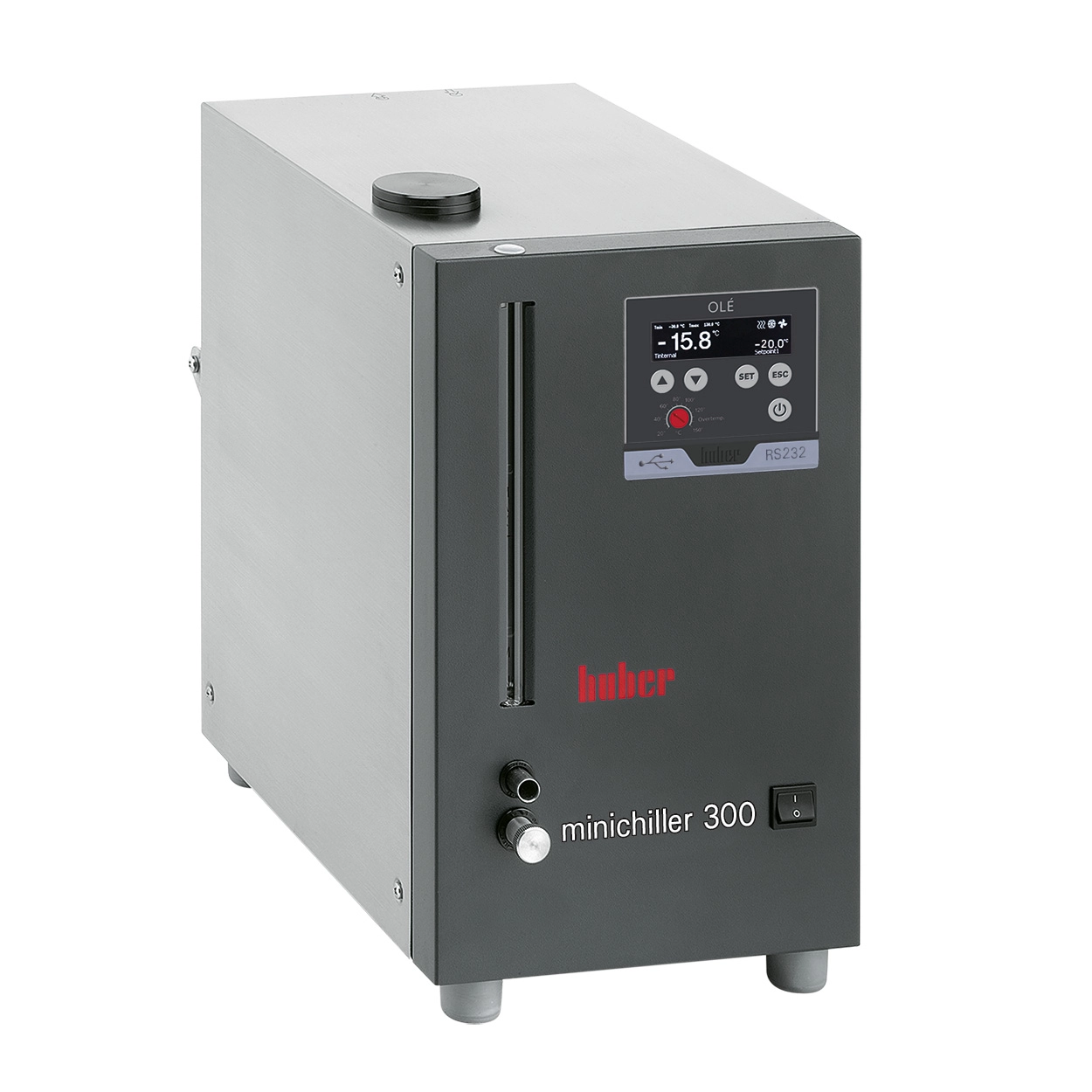
Primary Category: Best On A Budget Key Specs Temperature Range: -20°C to +40°C Cooling Capacity: 0.3 kW (at 15°C) Refrigerant: Natural R290 (Propane) Dimensions: Compact benchtop footprint (225 x 360 x 380 mm) Performance & Applications
The Huber Minichiller 300 OLÉ proves that budget-friendly equipment does not need to sacrifice sustainability or precision. It utilizes natural R290 refrigerant, ensuring compliance with strict new environmental regulations like the EU F-Gas Regulation (EU) 2024/573. While it lacks the high cooling power of industrial units, its 300-watt capacity is perfectly sized for cooling rotary evaporators, small bioreactors, or distillation apparatuses. The OLÉ controller provides a simple, bright OLED display with straightforward menu navigation, making it an excellent choice for educational labs or facilities needing a dedicated cooler for a single piece of benchtop equipment. Price Range: $22,000 – $24,000
Best For: Demanding External Processes
Primary Category: Best For Speed / Throughput Key Specs Temperature Range: -30°C to +120°C Pump Flow Rate: Up to 40 L/min Pressure: Max 3.5 bar (Adjustable bypass) Connectivity: Ethernet, USB, and Pt100 interface standard Performance & Applications
For applications requiring rapid temperature changes and high flow rates, the LAUDA Integral IN 130 T stands out as a process thermostat rather than a simple cooler. This "New Generation" model features a modular interface concept and a powerful pressure pump capable of overcoming the high resistance often found in micro-reactors or long tubing runs. Its small internal filling volume ensures extremely fast heating and cooling ramps, making it ideal for dynamic process control in chemical engineering and material stress testing. The adjustable bypass allows operators to limit pressure protectively, ensuring sensitive glass reactors are not damaged during high-throughput operation. Price Range: $10,000 – $14,000
Best For: Eco-Friendly Versatility
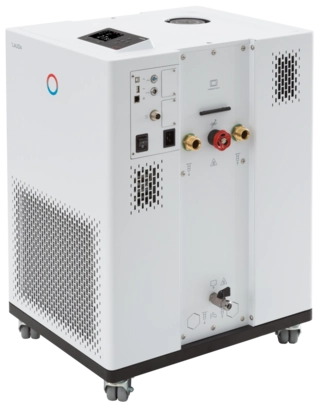
Primary Category: Most Versatile Key Specs Temperature Range: -20°C to +85°C (H Series) Cooling Capacity: Scalable options (approx. 0.8 – 1.8 kW) Refrigerant: Natural refrigerants (R290) Release Year: 2024/2025 Performance & Applications
Released as part of Julabo's new generation of environmentally conscious recirculating coolers, the VALEGRO H Series is designed to be a laboratory all-rounder. It combines a wide working temperature range with a robust pump system that can be precisely controlled via a modern touchscreen interface. The unit supports predictive maintenance through advanced data logging and fits seamlessly under standard lab benches due to its compact design. Its versatility makes it suitable for everything from replacing tap water cooling in multiple rotary evaporators to controlling the temperature of electrophoresis chambers or refractometers. Price Range: $75,000 – $85,000
Best For: Extreme Temperature Control
Primary Category: Best High-End Option Key Specs Temperature Range: -85°C to +250°C Cooling Capacity: 2.4 kW (at 200°C) down to 0.6 kW (at -60°C) Controller: Pilot ONE (Touchscreen, E-grade Professional) Technology: Hydraulically sealed system (No fluid vapors, no oxidation) Performance & Applications
The Huber Unistat 825 represents the pinnacle of dynamic temperature control systems. Utilizing a hydraulically sealed fluid circuit, it prevents the formation of oil vapors and oxidation, significantly extending the life of the thermal fluid. The 2024/2025 updates to the Unistat line have integrated CO2 (R-744) refrigerant options, aligning high-end performance with future-proof sustainability. This unit provides exceptionally fast cooling and heating rates, making it indispensable for scale-up processes in pharmaceutical production, reaction calorimetry, and stress testing of automotive components where temperature profiles must be simulated with absolute precision. Model Best For Key Features Typical Price Range PolyScience DuraChill Portable Overall Reliability Self-changing filter, UV light, WhisperCool™ noise reduction $8,500 – $11,500 Huber Minichiller 300 OLÉ Budget / Routine Natural refrigerant (R290), compact design, OLED display $5,500 – $6,500 LAUDA Integral IN 130 T Speed / Throughput High-pressure pump (3.5 bar), rapid temp changes, modular interfaces $22,000 – $24,000 Julabo VALEGRO H Series Versatility New 2025 generation, extended temp range, predictive maintenance $10,000 – $14,000 Huber Unistat 825 High-End Precision -85°C to 250°C range, sealed hydraulic system, Pilot ONE controller $75,000 – $85,000 Selecting the correct lab chiller in 2026 involves balancing initial capital capability with long-term operational costs and environmental compliance. While the Huber Minichiller 300 OLÉ offers an excellent entry point for standard tasks, advanced facilities will benefit from the data integration and rapid thermodynamics found in the LAUDA Integral and Huber Unistat series. Investing in these modern, eco-friendly systems ensures compliance with evolving F-Gas regulations while maximizing the reproducibility of scientific data. This article was created with the assistance of Generative AI and has undergone editorial review before publishing.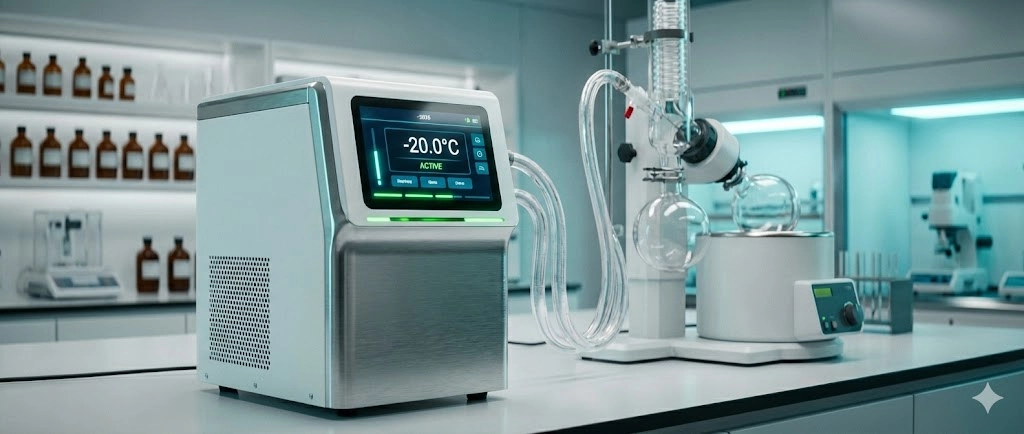
Quick Summary
PolyScience DuraChill Portable – PolyScience
Huber Minichiller 300 OLÉ – Peter Huber Kältemaschinenbau AG
LAUDA Integral IN 130 T – LAUDA
Julabo VALEGRO H Series – Julabo
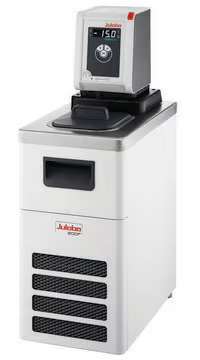
Huber Unistat 825 – Peter Huber Kältemaschinenbau AG
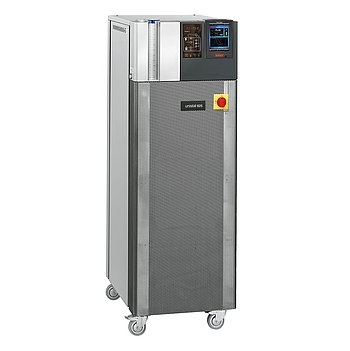
Comparison Table
Final Thoughts on 2026 Laboratory Chillers
Jan 09, 2026
Product News
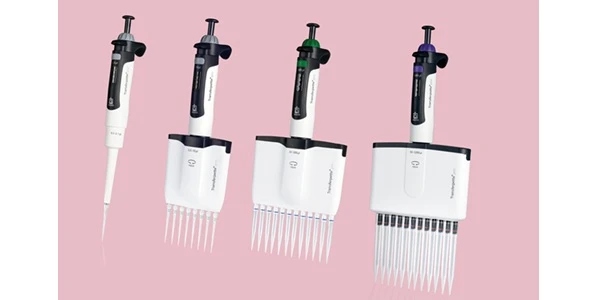
BRANDTECH Scientific Introduces the Transferpette® pro Micropipette: A New Twist on Comfort and Control
The latest addition to its trusted line of precision liquid handling instruments, engineered for comfort, control, and repeatable accuracy.

Jan 06, 2026
Featured, Technical Insight
New Research Frontiers Unlocked by Next-Generation Flow Cytometry
Next-generation flow cytometry systems using acoustic focusing are opening entirely new areas of research that were previously impractical or inaccessible with conventional flow cytometers.
Jan 05, 2026
Buying Guides
The Bottom Line: How Smart Microcentrifuge Tube Choices Impact Lab Efficiency and Cost
Innovative microcentrifuge tube solutions are more than just lab consumables—they’re strategic tools that can reduce costs, improve outcomes, and support long-term sustainability goals.
Jan 05, 2026
Buying Guides
Future-Proofing Your Lab with Innovative Microcentrifuge Tube Solutions
As laboratories evolve to meet the growing demands of modern science, even the most basic tools—like microcentrifuge tubes—are being reimagined.
Jan 05, 2026
Buying Guides
Microcentrifuge Tube Innovations: Driving Sustainable Change
Integrating next-generation consumables into standard workflows can lead to a more sustainable and responsible research environment.
Jan 05, 2026
Buying Guides
Single Use Plastics: How to Manage these Major Contributors to Lab Waste
Reducing lab waste isn’t just a sustainability issue—it’s a financial and operational one, too.
Jan 05, 2026
Buying Guides
Common Microcentrifuge Tube Challenges in Sensitive Molecular Workflows
Key factors that can impact the performance of microcentrifuge tubes for PCR, qPCR, and NGS and other sensitive applications
Jan 05, 2026
Buying Guides
How to Research the Right Microcentrifuge Tubes for Your Application
Selecting the right microcentrifuge tubes starts with understanding the specific demands of your application.
Jan 05, 2026
Technical Insight
The Best Confocal Microscopes of 2026
Discover the best confocal microscopes of 2026 for advanced imaging. Compare top models from Zeiss, Evident, and Nikon for speed, resolution, and budget.

Dec 24, 2025
Featured, Popular Products, Technical Insight
Emerging Mass Spectrometry Technologies to Improve Intraoperative Diagnostics
Advances in mass spectrometry may soon reshape surgery, improving diagnostic accuracy and impacting post-operative outcomes